The Incredible 'Everything' Farm: One Player Grows Every Crop in Stardew Valley
Stardew Valley player's 'everything' farm grows all crops, using Ginger Island's year-round climate and meticulous layout for perfection.
On a crisp autumn afternoon in 2026, the Stardew Valley online forums lit up with a post that would soon become legendary among the community. A player known simply as brash_bandicoot had just unveiled a sprawling farm layout unlike any other. It wasn’t the typical display of keg-filled sheds or carefully arranged bee houses. Instead, every tile of tilled soil told a story of meticulous planning and stubborn patience. This was the \u201ceverything\u201d farm \u2014 a single save file that cradled every single crop the game had to offer.
The idea had first sprouted in brash_bandicoot\u2019s mind during a late-night play session back in 2024, shortly after the massive 1.6 update had injected fresh life into Pelican Town. That update brought not only the vibrant Desert Festival and a brand-new farm map, but also a handful of rare crops like powdermelons, broccoli, summer squash, and carrots. While most players were content to dabble in a few seasonal rotations, brash_bandicoot imagined something far grander. What if a single farm could showcase the complete agricultural diversity of the entire game? It was a challenge that would demand every ounce of game knowledge and a serious commitment of in-game years.
The first hurdle was space. Even with the largest Standard Farm layout, fitting every variety of vegetable, fruit, grain, and flower in neat, waterable plots was a logistical puzzle. Brash_bandicoot refused to sacrifice aesthetics for efficiency, so every row had to be immaculate. The Greenhouse became a sanctuary for the most delicate crops \u2014 ancient fruit, starfruit, and sweet gem berries \u2014 while the main field was reserved for the staples that changed with the seasons. But the true secret weapon lay far to the southeast, across the waves of the Gem Sea: the Ginger Island riverbed farm.
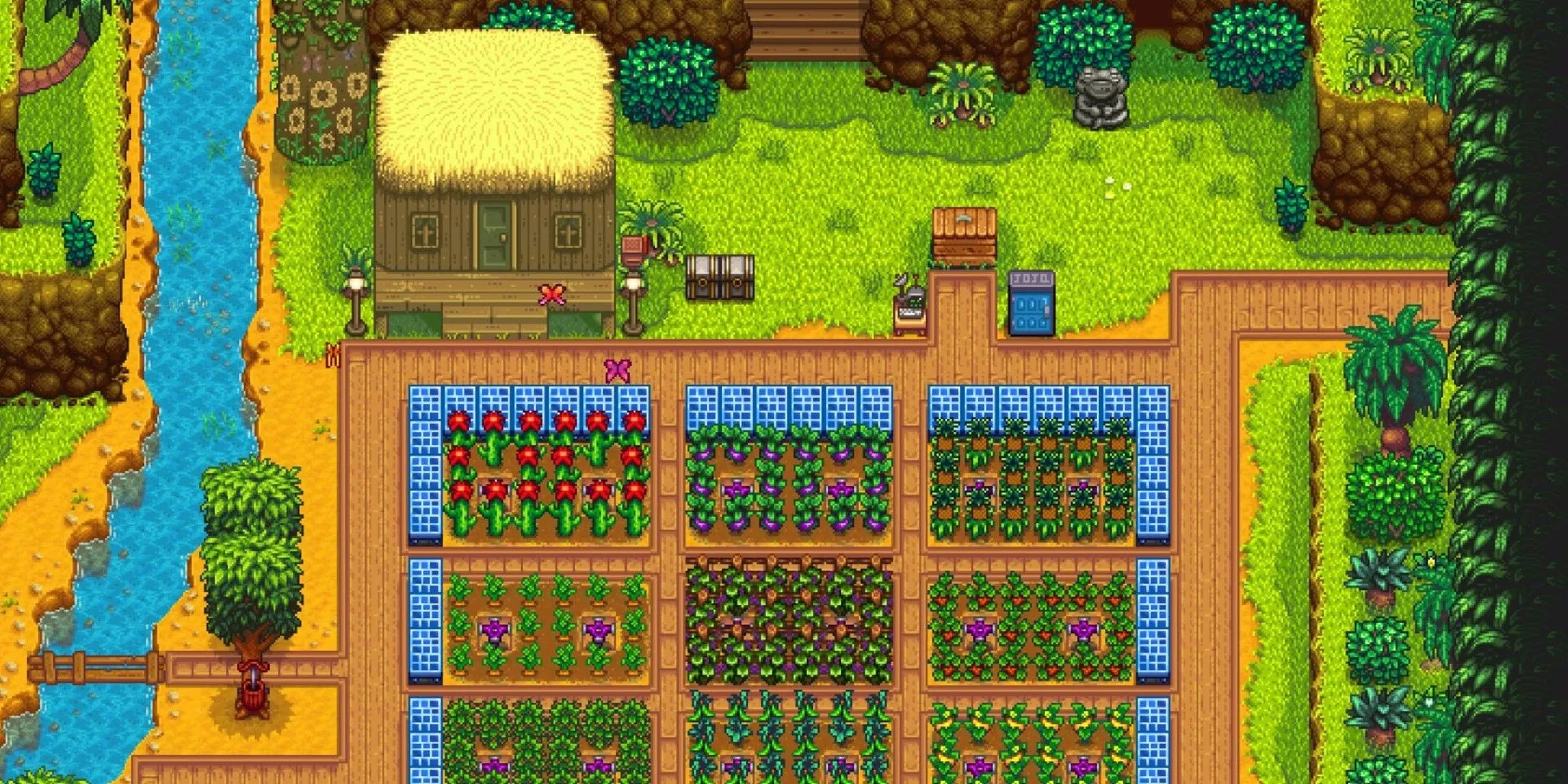
Ginger Island, accessible after completing the Community Center (or Joja Warehouse) and repairing the boat, offers a year-round growing climate free from crows. This turned out to be the perfect canvas. Brash_bandicoot spent countless hours tilling its rich soil, carefully dividing the area into sections for each crop category. Using over 130 iridium sprinklers, the farm hummed with automated perfection. A single Junimo hut stood guard over the most plentiful plot, its tiny inhabitants happily plucking ripe produce while the player was busy elsewhere.
Collecting the seeds themselves became a quest arc worthy of its own adventure. Most crops in Stardew Valley are strictly seasonal, and some are only obtainable from the Traveling Cart, the Night Market, or by processing specific foraged goods through a Seed Maker. Ancient Seeds had to be painstakingly dug up from artifact spots and coaxed into life. Rare mixed seeds demanded constant hoeing of the dirt patches scattered across the mines. The player even befriended Sandy in the Calico Desert to unlock her exclusive stock of rhubarb and starfruit seeds. The greatest satisfaction, he later admitted, came from finally holding a packet of Qi Fruit seeds after completing a particularly fiendish Mr. Qi quest.
Then there were the giant crops. Cauliflower, melon, and pumpkin can, under very specific conditions, merge into massive, three-by-three behemoths that yield double the normal harvest. Achieving these on demand was an exercise in controlled chaos. Brash_bandicoot had to leave fully mature crops in the ground for days, sacrificing potential profits, while praying that the overnight RNG would bless the chosen plots. After multiple failed attempts and one heartbreak where a misplaced sprinkler blocked a melon\u2019s growth, all three giant crops finally stood proudly on the farm. It was, he confessed, the most difficult part of the entire project.
The response from the Stardew Valley community was immediate and heartfelt. Fellow farmers flooded the comment section with awe-struck emojis and questions about seed logistics. One player joked that the farm looked less like a working field and more like a museum of agronomy. Another mused about the sheer willpower required to resist harvesting a single accidental strawberry that would have ruined the aesthetic. Brash_bandicoot took it all in stride, patiently explaining that the whole endeavour had consumed just over three full in-game years \u2014 nearly 350 hours of real time \u2014 and had tested his sanity more than once. Yet there was no regret. Only the quiet pride of someone who had set an absurd goal and watched it blossom into something beautiful.
Looking back from 2026, this \u201ceverything\u201d farm remains a shining example of why Stardew Valley continues to captivate millions. The 1.6 update, now a couple of years old, still fuels a steady stream of creative farm designs, community art, and mods that push the boundaries of what\u2019s possible in the sleepy valley. In an age of hyper-competitive online gaming, brash_bandicoot\u2019s tale is a gentle reminder that sometimes the most satisfying victories come from simple dirt, a handful of seeds, and the audacity to plant them all. The valley, it seems, is far from done growing.
Leave a Comment
0 Comments