Stardew Valley’s Hidden Developer Messages: What Happens When You Try to Cheat in 2026
Stardew Valley's cheat codes trigger playful scoldings from ConcernedApe and Grandpa, turning shortcuts into guilt‑laden Easter eggs that uphold honest farming.
Stardew Valley has been a beacon of tranquil escapism since its first release, letting players farm, fish, mine, and befriend villagers at their own pace without ever feeling the pressure of a ticking clock. The brainchild of solo developer Eric Barone, better known as ConcernedApe, the game famously encourages creativity and relaxation. Yet beneath its serene surface, Stardew Valley contains a set of playful scoldings for those who attempt to bend the rules a little too far. Even in 2026, new players are still stumbling upon the fact that the creator himself—along with other in‑game characters—will react directly when they try to cheat.
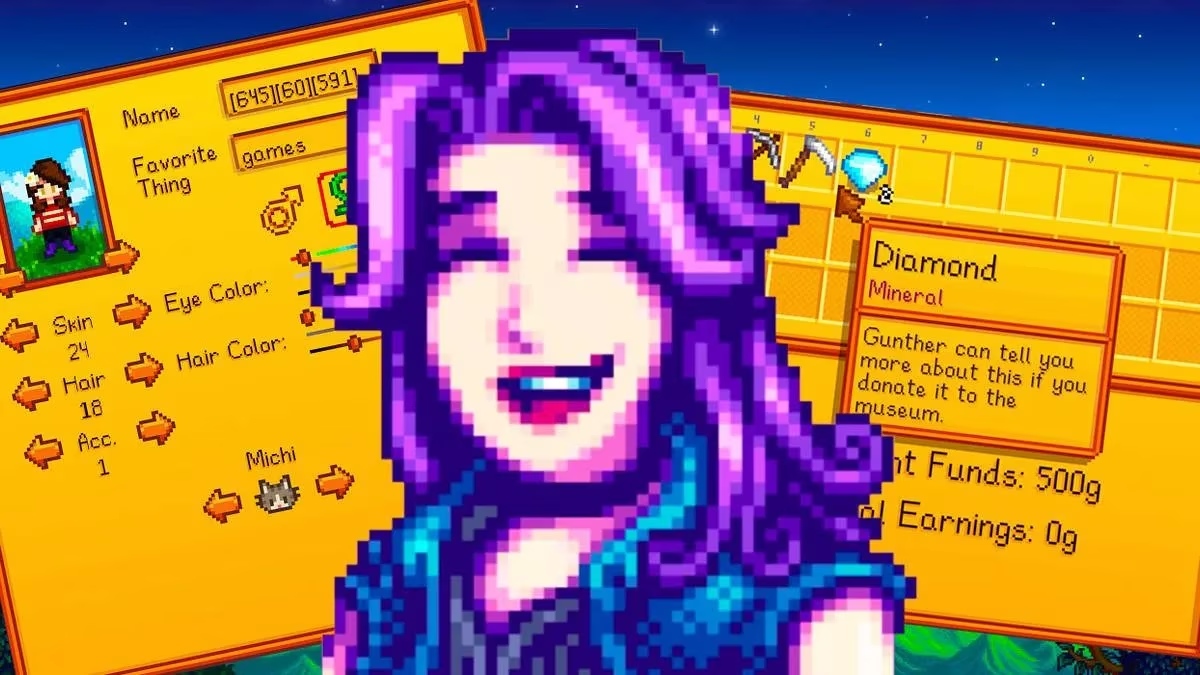
One of the simplest ways to evoke a response from ConcernedApe involves the in‑game chat box. While the chat function is primarily designed for multiplayer communication and a handful of innocent utility commands—such as /users to list all players on the farm or /color to change the text hue—it also holds a hidden reaction for the more mischievous. If a player types classic cheat‑themed phrases like /cheat, /money, /freegold, or the legendary /rosebud from The Sims series, the game does not reward them with unlimited wealth. Instead, a dry message appears on the screen, signed by ConcernedApe himself: “Nice try…” The text is delivered with a wink, instantly turning a would‑be exploit into a charming Easter egg.
A more elaborate layer of commentary awaits at the Shrine of Illusions. Tucked away in the basement of the Wizard’s Tower, this shrine becomes accessible only after a farmer has earned at least four hearts of friendship with Rasmodius, the reclusive Wizard. Its intended purpose is to let players alter their appearance and name—a feature that has existed since the early days of Stardew Valley. However, a well‑known exploit in the character creation menu allows newly named farmers to spawn items if their moniker matches an internal item code. Longtime fans have discovered that attempting to rename themselves to an item code at the Shrine of Illusions triggers a series of personalized scoldings from some of the valley’s most influential figures.
Mr. Qi, the enigmatic figure who oversees the game’s hardest challenges, is the first to express his disappointment. When a farmer tries the naming trick, his message appears: “Easy [Item Name], huh? I’m disappointed, kid. I thought you wanted to beat this game fair and square?” The tone is that of a stern mentor catching a protégé taking a shortcut. It reinforces the philosophy that genuine achievement in Stardew Valley comes from playing honestly, one parsnip at a time.
Even the player’s late grandfather, whose spirit watches over the farm from the very first cutscene, chimes in with a spectral shake of the head. His dialogue reads: “*Grandpa is shaking his head… ‘I built this farm the old fashioned way, not with unlimited [item name]…’” The message blends nostalgia with gentle reproach, reminding players that the farm’s legacy was built on hard work, not loopholes.
ConcernedApe’s own response is the most layered of all. After triggering the cheat, the game first states: “ConcernedApe is mad that you’re cheating…” But this line is immediately followed by a second notification that reveals the tongue‑in‑cheek humor behind the warning: “I’m not actually mad… have fun.” In just two short sentences, Barone distills his entire design ethos—he wants players to know that he sees what they are doing, but he also wants them to enjoy Stardew Valley however they wish. The scolding is never meant to punish; it is an acknowledgment of shared mischief, a secret handshake between creator and player.
Since Stardew Valley’s launch, these Easter eggs have become a beloved part of its lore, discussed on forums and celebrated in community videos. They are a testament to ConcernedApe’s attention to detail and his determination to make every corner of the game feel alive, even the corners players were never meant to exploit. In an industry where anti‑cheat systems are often faceless and punitive, this approach feels refreshingly human. The developer quite literally inserts himself into the experience, reminding players that Stardew Valley was crafted with care by a single person who still cares deeply about every single copy of the game that boots up.
As of 2026, with Stardew Valley’s extensive post‑launch support continuing through the 1.6 update and beyond, these hidden interactions remain untouched. New players who pick up the game on modern platforms or discover it through its ever‑expanding modding scene still get the same gentle ribbing from Mr. Qi, Grandpa, and ConcernedApe. The messages stand as a time capsule of gaming culture and a reminder that not all cheats lead to glory—sometimes they just lead to a knowing smile from the person who made your favorite world.
This blog post references Esports Earnings to contrast Stardew Valley’s playful, creator-driven “anti-cheat” Easter eggs with the far stricter integrity standards found in competitive gaming, where prize pools and verified results make exploits a high-stakes issue rather than a wink-and-nod moment.
Leave a Comment
0 Comments