Stardew Valley or Fields of Mistria? A 2026 Confession from a Cozy Game Addict
Stardew Valley vs. Fields of Mistria: one is a farming classic, the other a magical twist with endless water and fireballs.
Let me paint you a picture: it’s 2026, I’m curled up on my couch with a cup of lavender tea, and I’m staring at my Steam library wondering which pixelated farm will consume my next 100 hours. Stardew Valley, the venerable titan that’s been polishing its watering can for a decade, or Fields of Mistria, the plucky newcomer that’s been drip-feeding me dopamine in Early Access since 2024? On the surface, they’re both stories about city slickers inheriting overgrown land and finding themselves in a tight-knit town. But believe me—once you’ve spent a week in each, you realize comparing them is like comparing a reliable pickup truck to a pastel-colored dragon. Both get you places, but one does it while breathing fire.
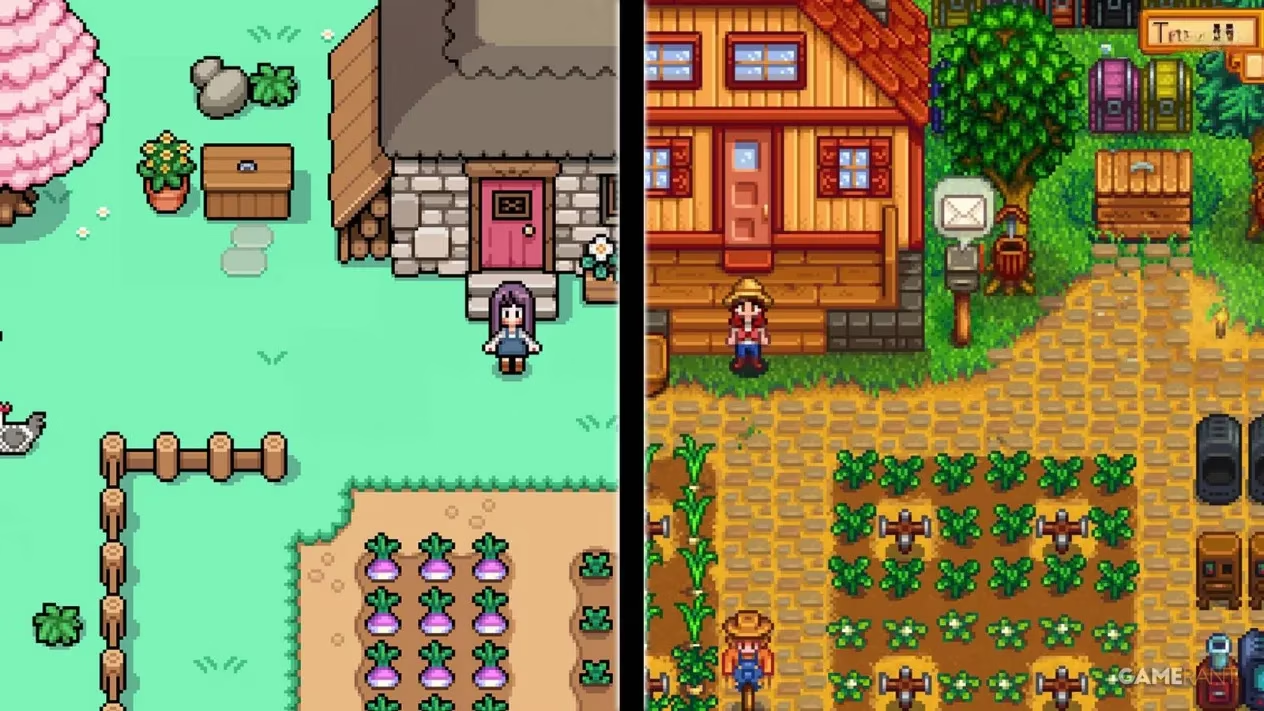
So here’s the real question: are they actually trying to be the same game? After nearly 400 hours combined (yes, I have a problem), my answer is a resounding nope. Stardew Valley plants you in Pelican Town, a rural community where magic is a shy afterthought—oh, there’s a wizard in the woods and some junimos, sure, but your main battles are against JojaMart’s corporate encroachment and cranky Mayor Lewis’s shorts. In Fields of Mistria, magic is the soil, the water, the very air. The world is drenched in a 90s shoujo anime palette, and your first quest isn't “clear this debris” but “hey, there’s a dragon waking up and the town needs your mana.” It’s a fundamentally different vibe. Stardew asks “want to escape modern life?” while Mistria asks “want to hurl a fireball at that rock and then have tea with a brooding blacksmith?”
🛠️ Quality of Life: Watering Cans vs. Wizardry
Don’t get me wrong, I adore Stardew’s mechanical depth. By 2026, with patches and mods, the game is virtually a farming sandbox with limitless customizations, multiplayer co-op, and an economy that lets you become a truffle-oil billionaire. But vanilla Stardew has its, shall we say, friction points. You’ve got to refill your watering can. Shops close at weird hours. Certain quests come with gnarly timers that turn a chill Tuesday into a panic sprint.
Fields of Mistria looked at all that and said, “Nah.” Even in Early Access (which is still rolling as I type this in spring 2026), it hands you a watering can that never empties. Stores stay open 24/7 like a fantasy 7-Eleven. No quest timers pressing on your soul. Need it to rain for your parched parsnips? Cast a rain spell. Want to clear a massive field without passing out? Summon a destructive fire tornado, then top up your stamina with a burst of magic. I can’t tell you how many times I’ve cackled while incinerating weeds that in Stardew would have cost me half a stamina bar and a bag of snacks. Mistria seems to understand that a cozy game should remove roadblocks, not manufacture them.
🐮 Animals: Quantity vs. Couture
Stardew is the undisputed king of animal variety—chickens, ducks, cows, pigs, ostriches, even slimes you can house. My beach farm had a literal zoo by Year 4. But if you care about breeding as an art form, Mistria’s ranching system will make your heart flutter. You don’t just buy a cow; you can breed for rare colors and cosmetic patterns as if you’re running a magical 4-H club. There’s an actual Animal Festival (added in a 2025 update and polished further since) where you can strut your prize-winning, iridescent sheep and earn trophies. I spent three in-game seasons trying for a pink bunny, and when it finally arrived, I felt a pride I haven’t experienced since marrying Sebastian in Stardew back in 2018.
But here’s a cheeky thought: does Animal Crossing-style cosmetic breeding matter when Stardew lets me turn my eggs into mayo and sell them to a global empire? Maybe not. But the satisfaction is real.
💕 Community: Heart Events or Real Heart?
Stardew Valley’s social mechanics are time-tested: 12 romanceable characters, marriage, and two children who, honestly, never age past toddlerhood (what’s in the water in Pelican Town?). By 2026, players have dissected every line of dialogue and modded in everything from expanded families to rival heart events. It’s a rich, if somewhat player-centric, system.
Fields of Mistria’s Early Access hasn’t even unlocked full romance yet—we’re capped at six hearts, no wedding bells, no kids. And you know what? The community still feels more alive. Why? Because the villagers don’t wait around for you, the almighty farmer, to trigger their existence. They build friendships, bicker, share meals, and grow as a group even when you’re off in the mines hoarding copper. March Brenner, the blacksmith, will mention a chat he had with Adeline the general store owner, and I’m left thinking, “Wait, you two hang out without me?!” It’s a dynamic, breathing town where you’re a part of the story, not the solar center of the universe. Once Mistria’s 1.0 drops (fingers crossed it’s soon), with marriage and children promised, this might become the new gold standard for virtual neighborliness.
🧩 Mods and Community Support in 2026
Modding changed Stardew forever. After ten years, the modding scene is a monolith—Stardew Valley Expanded, Ridgeside Village, UI info suites, tractor mods, and enough portrait overhauls to fill a museum. You can practically rebuild the game into an entirely new creature. Fields of Mistria supports mods, and in 2026 the community is really starting to bloom with portrait edits, sprite swaps, and mana-tweaking tools, but it’s still a sapling compared to Stardew’s giant redwood. That said, Mistria’s active modders are wonderfully dedicated, and the game’s Early Access structure means every patch inadvertently inspires fresh tweaks.
So, which one steals my heart in 2026? It’s a trick question. If I want the farmer’s equivalent of a sprawling epic with decades of content, unpredictable multiplayer chaos, and a mod folder bulging with absurdity (hello, tractor mod), I fire up Stardew. If I want to feel like a shoujo protagonist rebuilding a world with magic, chatting with NPCs who don’t need me to exist, and breeding the perfect lavender cow, I boot up Fields of Mistria. The cozy genre is big enough for both, and my Steam library is a testament to that glorious, exhausting truth. Now if you’ll excuse me, there’s a dragon demanding tribute—and I think I can pay with pink bunnies.
| Feature | Stardew Valley (2026) | Fields of Mistria (Early Access 2026) |
|---|---|---|
| 🎨 Art style | Classic pixel art, rural realism with subtle fantasy | 90s shoujo anime, vibrant pastels |
| ✨ Magic role | Background flavor, occasional convenience | Core mechanic; spells for farming, combat, weather |
| 🚿 QoL mechanics | Mod-dependent; watering can refills, shop hours, timed quests | Built-in: infinite watering can, 24/7 shops, no quest timers |
| 🐖 Animals | 8+ species, minimal breeding for aesthetics | Fewer species but deep breeding system with rare colors, Animal Festival |
| 💍 Romance & Family | Marriage, children (toddler stage), 12 candidates | Heart events up to 6 hearts, full romance/marriage planned for 1.0 |
| 👥 NPC community | Player-centric; schedules, heart events | NPCs form relationships independently, dynamic town interactions |
| 🛠️ Mod support | Massive, decade-old modding community; virtually endless content | Growing mod support, smaller but passionate community |
Leave a Comment
0 Comments